Showing posts with label BANK PO. Show all posts

Wednesday, 16 February 2022

Anti-mob lynching bills: why in news? recent incidents of mob lynching

 Bills passed against mob lynching in the past four years by at least four States have not been implemented with the Union government taking a view that lynching is not defined as a crime under the Indian Penal Code (IPC).

  • These states include Jharkhand, Rajasthan, West Bengal and Manipur.

Why have the bills been delayed so much?

In 2019, the MHA informed the Lok Sabha that it had received the bills passed by the State legislatures that have been reserved by the Governor for consideration of the President.

  • The President has to go with the advice given by the Council of Ministers, in the case of such legislation, represented by the MHA.
  • The Ministry examines the State legislations on three grounds— repugnancy with Central laws, deviation from national or central policy and legal and constitutional validity. 

Recent incidents of mob lynching in India

  • In December 2021, a man was lynched to death by the Sikh Sangat (Sikh devotees) in Shri Harmandir Sahib Gurudwara (Golden Temple) in Amritsar over an alleged attempt to disrespect the holiest book of Sikh religion, Shri Guru Granth Sahib Ji.
  • In 2021 in Assam, a 23-year-old student leader was allegedly killed by a mob.
  • In 2021 October a man was allegedly lynched, his limbs cut off and left to die at the Singhu Border, site of the farmers’ protest against the three farm laws.
  • In 2021 August, a bangle seller in Indore was reportedly beaten up by a mob for allegedly hiding his identity.
  • The man survived and was sent to judicial custody.
  • In 2021 May, a 25-year-old Gurugram man was allegedly lynched when he went out to buy medicines. 

What is meant by Lynching? Why in news ?

Any act or series of acts of violence or aiding, abetting (encouraging) such act/acts thereof, whether spontaneous or planned, by a mob on the grounds of religion, race, caste, sex, place of birth, language, dietary practices, sexual orientation, political affiliation, ethnicity or any other related grounds. 

How are these cases handled?

There is “no separate” definition for such incidents under the existing IPC. Lynching incidents can be dealt with under Section 300 and 302 of IPC.

  • Section 302 provides that whoever commits murder shall be punished with death or imprisonment for life and shall also be liable to fine. Offence of murder is a cognisable, non- bailable and non-compoundable offence.

SC guidelines about mob lynching

  • There should be a “separate offence” for lynching and the trial courts must ordinarily award maximum sentence upon conviction of the accused person to set a stern example in cases of mob violence.
  • The state governments will have to designate a senior police officer in each district for taking measures to prevent incidents of mob violence and lynching.
  • The state governments need to identify districts, sub-divisions and villageswhere instances of lynching and mob violence have been reported in the recent past.
  • The nodal officers shall bring to the notice of the DGP about any inter-district co-ordination issues for devising a strategy to tackle lynching and mob violence related issues.
  • Every police officer shall ensure to disperse the mob that has a tendency to cause violence in the disguise of vigilantism or otherwise.
  • Central and the state governments shall broadcast on radio, television and other media platforms about the serious consequences of mob lynching and mob violence.
  • Despite the measures taken by the State Police, if it comes to the notice of the local police that an incident of lynching or mob violence has taken place, the jurisdictional police station shall immediately lodge an FIR.
  • The State Governments shall prepare a lynching/mob violence victim compensation scheme in the light of the provisions of Section 357A of CrPC.
  • If a police officer or an officer of the district administration fails to fulfill his duty, it will be considered an act of deliberate negligence.

Monday, 14 February 2022

Supreme court refuses plea for including madrasas, Vedic schools under RTE

The Supreme Court has refused to intervene in a petition challenging sections of the Right to Education Act of 2009 which exclude vedic pathsalas , madrasas and institutions imparting religious education from its ambit.

  • The Court observed that the exclusion of these institutions was specifically inserted into the 2009 Act by an amendment of August 2012 and since then there has never been any controversy in the past decade.

What’s the issue?

The petitioner said, Right of a child should not be restricted only to free education, but must be extended to have equal quality education without discrimination on the ground of child’s social economic and cultural background. Therefore, the court may declare Sections 1(4) and 1(5) of the 2009 Act arbitrary and irrational.

Sections 1(4) and 1(5) of the 2009 Act:

Section 1(5) of the Act states, “Nothing contained in this Act shall apply to madrasas, Vedic pathshalas and educational institutions primarily imparting religious instruction”.

Section 1(4) says, “Subject to the provisions of Articles 29 and 30 of the Constitution, the provisions of this Act shall apply to conferment of rights on children to free and compulsory education.

  • Article 29 and 30 contain provisions securing rights of minorities and minority-run institutions.

Constitutional Provisions regarding Minority Educational Institutions:

Article 30(1) recognizes linguistic and religious minorities but not those based on race, ethnicity.

  • It recognizes the right of religious and linguistic minorities to establish and administer educational institutions, in effect recognizing the role educational institutions play in preserving distinct culture.
  • A majority community can also establish and administer educational institutions but they will not enjoy special rights under Article 30(1)(a).


Special rights enjoyed by religious minority institutions are:

  1. Under Art 30(1)(a), MEI enjoy right to education as a Fundamental Right. In case the property is taken over by state, due compensation to be provided to establish institutions elsewhere
  2. Under Article 15(5), MEIs are not considered for reservation
  3. Under Right to Education Act, MEI not required to provide admission to children in the age group of 6-14 years upto 25% of enrolment reserved for economically backward section of society
  4. In St Stephens vs Delhi University case, 1992, SC ruled that MEIs can have 50% seats reserved for minorities
  5. In TMA Pai & others vs State of Karnataka & others 2002 case, SC ruled that MEIs can have separate admission process which is fair, transparent and merit based. They can also separate fee structure but should not charge capitation fee.


Geomagnetic storm: Elon Musk’s Starlink has lost 40 satellites that were caught in a geomagnetic storm

Recently, Elon Musk’s Starlink has lost 40 satellites that were caught in a geomagnetic storm a day after they were launched.
However, these satellites have not created any space debris as the satellites were designed to burn up on reentry into the Earth’s atmosphere.

What is Geomagnetic Storm.

geomagnetic storm, also known as a magnetic storm, is a temporary disturbance of the Earth's magnetosphere caused by a solar wind shock wave and/or cloud of magnetic field that interacts with the Earth's magnetic field.
The disturbance that drives the magnetic storm may be a solar coronal mass ejection (CME) or (much less severely) a co-rotating interaction region (CIR), a high-speed stream of solar wind originating from a coronal hole. The frequency of geomagnetic storms increases and decreases with the sunspot cycle. During solar maximum, geomagnetic storms occur more often, with the majority driven by CMEs.
The increase in the solar wind pressure initially compresses the magnetosphere. The solar wind's magnetic field interacts with the Earth's magnetic field and transfers an increased energy into the magnetosphere. Both interactions cause an increase in plasma movement through the magnetosphere (driven by increased electric fields inside the magnetosphere) and an increase in electric current in the magnetosphere and ionosphere. During the main phase of a geomagnetic storm, electric current in the magnetosphere creates a magnetic force that pushes out the boundary between the magnetosphere and the solar wind.

Why In News

Elon Musk’s Starlink has lost dozens of satellites that were caught in a geomagnetic storm a day after they were launched on February 3. Up to 40 of the 49 satellites were impacted, Starlink said, causing them to fall from orbit before they could be commissioned.
“(Rocket) Falcon 9’s second stage deployed the satellites into their intended orbit, with a perigee of approximately 210 km above Earth, and each satellite achieved controlled flight. Unfortunately, the satellites deployed on Thursday (February 3) were significantly impacted by a geomagnetic storm on February 4,” Starlink said in a statement on Tuesday.

Solar storms/flares

Solar storms are magnetic plasma ejected at great speed from the solar surface. They occur during the release of magnetic energy associated with sunspots (‘dark’ regions on the Sun that are cooler than the surrounding photosphere), and can last for a few minutes or hours. The solar storm that deorbited the satellites occurred on February 1 and 2, and its powerful trails were observed on February 3.

“The emerging data suggest that the passing of the latter part of the storm, with its high density core, possessed speeds higher than what was recorded during the storm’s arrival — something we did not expect,” said physicist Prof Dibyendu Nandi, head of the Centre of Excellence in Space Sciences India (CESSI) at the Indian Institute of Science Education and Research (IISER), Kolkata.
The storm was unusual, an unexpectedly extended event and of a kind not seen in the recent past, Prof Nandi said.

Effect on Earth

Not all solar flares reach Earth, but solar flares/storms, solar energetic particles (SEPs), high-speed solar winds, and coronal mass ejections (CMEs) that come close can impact space weather in near-Earth space and the upper atmosphere.
Solar storms can hit operations of space-dependent services like global positioning systems (GPS), radio, and satellite communications. Geomagnetic storms interfere with high-frequency radio communications and GPS navigation systems. Aircraft flights, power grids, and space exploration programmes are vulnerable.
CMEs, with ejectiles loaded with matter travelling at millions of miles an hour, can potentially create disturbances in the magnetosphere, the protective shield surrounding the Earth. Astronauts on spacewalks face health risks from possible exposure to solar radiation outside the Earth’s protective atmosphere.

Predicting solar storms

Solar physicists and other scientists use computer models to predict solar storms and solar activities in general. The February 1-2 phenomenon that knocked out Starlink’s satellites was predicted on January 29.
“Current models are capable of predicting a storm’s time of arrival and its speed. But the storm’s structure or orientation still cannot be predicted,” Prof Nandi said.
Certain orientations of the magnetic field can produce a more intense response from the magnetosphere, and trigger more intense magnetic storms.
With the increasing global dependence on satellites for almost every activity, there is a need for better space weather forecasts and more effective ways to protect satellites.
 
What are Geomagnetic Storms?

Geomagnetic storms are caused when events such as solar flares can send higher than normal levels of radiation towards Earth. This radiation interacts with the Earth’s magnetic field causing a geomagnetic storm.

Causes:

The disturbance that drives the magnetic storm may be a solar coronal mass ejection (CME) or (much less severely) a co-rotating interaction region (CIR), a high-speed stream of solar wind originating from a coronal hole.
 
Effects of Geomagnetic storms:

Effects from the geomagnetic storm can range from the appearance of auroras or the northern and southern lights to disruptions in communications systems due to high radiation. This would make it difficult to communicate with others on Earth.

Classification of Geomagnetic storms:

Geomagnetic storms are classified according to a scale that measures the effect that storms will have.
At its safest level, a G1 storm affects power grids by causing weak fluctuations, minor impacts on satellite operations, and causes the northern and southern lights to occur.
At its most extreme, G5, there would be voltage control problems with some grid system collapses or blackouts, radio waves wouldn’t be able to travel for one to two days, low-frequency radio would be out for hours, and the auroras would be able to be seen at lower latitudes than usual.

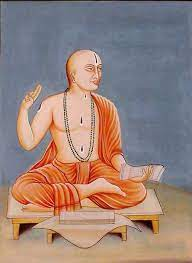
Shri Narendra Modi recently paid his obeisances to Sri Madhvacharya on the occasion of Madhva Navami.

 About Sri Madhvacharya:

Shri Madhvacharya was born near Udupi. He was born in 1238, on the auspicious day of Vijayadashami, and he was named Vasudeva.

  • He was the third of the trinity of philosophers who influenced Indian thoughts after the ages of the Vedas and Puranas (the other two being Shankaracharya and Ramanujacharya).
  • He propounded the philosophy of Dwaita or Dualism.
  • It was Achyutapreksha who gave him the title ‘Madhva’ by which he was more famously known.
  • Literary works: He wrote various texts that detailed his philosophy which he called Tattvavada, or as it is more popularly known, Dvaita. Some of his works were the Gita Bhashya, Brahma Sutra Bhashya, Anu Bhashya, Karma Nirnaya, and Vishnu Tattva Nirnaya.

 About Dvaita philosophy:

  • The basic tenet of Dvaita philosophy is the refutation of the Mayavada of Sri Shankara. Dvaitha emphasizes that the world is real and not just an illusion.
  • The soul is bound to this world through ignorance.
  • The way for the soul to release itself from this bondage is to seek the grace of Sri Hari.
  • To reach Sri Hari, one has to practice Bhakthi, there is no other way.
  • To practice Bhakthi, one needs to meditate.
  • To meditate, one needs to clear the mind and attain detachment by studying the sacred texts.

ISRO successfully launches EOS-04 radar imaging satellite, two others

 The Indian Space Research Organisation (ISRO) successfully launched earth observation satellite EOS-04 along with two other smaller passenger satellites aboard Polar Satellite Launch Vehicle at 5.59 am on February 14, 2022 from the first launch pad of Satish Dhawan Space Centre at Sriharikota in Andhra Pradesh.

ISRO tweeted after the launch saying, "India’s Polar Satellite Launch Vehicle PSLV-C52 injected Earth Observation Satellite EOS-04, into an intended sun-synchronous polar orbit of 529 km altitude at 06:17 hours IST on February 14, 2022 from Satish Dhawan Space Centre, SHAR, Sriharikota."

This was ISRO's first launch mission of 2022 and PSLV’s 54th flight. The launch comes almost six months after ISRO's GSLV-F10/EOS-03 mission failed on August 12, 2021. As per ISRO, the mission failed after the cryogenic upper stage ignition did not happen due to a technical anomaly.

PSLV-C52 mission 

The radar-imaging satellite, weighing 1710 kg, was deployed into a sun-synchronous polar orbit of 529 km around 17 minutes after liftoff.  Besides the earth observation satellite EOS-04, the mission also carried two small satellites as co-passengers, which were injected into the orbit a minute later.

The two passenger satellites include:

INSPIREsat-1: It is a student satellite from Indian Institute of Space Science & Technology (IIST) in association with University of Colorado's Laboratory of Atmospheric & Space Physics.

INS-2TD: This is a technology demonstrator satellite (INS-2TD) from ISRO, a precursor to India-Bhutan Joint Satellite (INS-2B).

EOS-04 Satellite

The EOS-04 satellite, also known as RISAT1, is a Radar Imaging Satellite. It has been designed to provide high-quality images under all weather conditions. The images will be used for applications such as agriculture, soil moisture and hydrology, forestry & plantations and flood mapping.

The countdown process of 25 hours and 30 minutes leading to the launch of the mission will begin at 04:29 hours on February 13th after getting a go-ahead from ISRO's Launch Authorization Board.

Tuesday, 8 February 2022

African Union Summit


Key Points on the summit

  • The countries discussed about the unavailability of COVID vaccines to many African countries
  • Lately African Union has been facing institutional failures because of insurgencies and coup. This fact was widely agreed by many of the members.
  • All the six recent military coups were discussed.
  • The summit announced that only 11% of the Africans are fully vaccinated.
  • Palestine wanted the African Union to withdraw the observer status of Israel.

What did Ethiopia say during the summit?

The Ethiopian Prime Minister Abhiy Ahmed addressed the summit. He announced to end the conflict with Tigrayan rebels.


What is the Tigray crisis?

The Tigray People Liberation Front was a political party. It was a part of the coalition government that ended the military dictatorship in 1991. The TPLF leader became the president of Ethiopia in 1991. Later in 1995, he became the first PM of Ethiopia. The coalition government is called EPRDF Ethiopian People Revolutionary Democratic Front. In 2018, the EPRDF chose Abhiy as the PM. Abhiy was a military intelligence officer. Since then the TPLF has been fighting against the government. The TPLF is threatening to fight a regional war in the Horn of Africa. The Horn of Africa houses Ethiopia, Djibouti, Somalia and Eritrea. The internal political crisis of Ethiopia is affecting other African countries as well.

Theme of the summit

  • Strengthening Resilience in Nutrition and Food Security on African continent
  • Strengthening agro – food systems, health and social protection systems to accelerate human, economic and social capital development

Increaisng Coup d’etat in Africa

Burkina Faso: In January 2022.

Zimbabwe: In 2017. Ended the 37 year rule of Robert Mugabe

Sudan has faced 17 coup d’etat, 7 by Chad, 7 by Niger, 8 by Nigeria, 11 by Burundi, 9 by comoros, 8 by Nigeria, 8 by Benin, 8 by Mali, 10 by Ghana, 10 by Sierra Leone, 9 by Guinea Bissau, 9 by Burkina Faso. All these occurred between 1952 and 2021.


Intensified Mission Indradhanush (IMI) 4.0

Key Facts

  • India is running the largest inoculation drive globally in which more than 3 crore pregnant women and 2.6 crore children are covered through Universal Immunisation Programme annually.
  • The IMI 4.0 will have three rounds and it will be conducted across 416 districts, across 33 states and UTs. It also includes 75 districts identified for Azadi ka Amrit Mahotsav.
  • On the occasion, IMI 4.0 portal was also launched.
  • Minister also released the “Operational Guidelines for IMI 4.0 – “Strengthening Immunisation in Urban Areas-A framework for Action”. It is a handbook for “Mahila Arogya Samiti on Urban Immunisation”.

Significance of the programme

  • This programme will immensely contribute in filling the gaps as well as make lasting gains for universal immunisation.
  • It will ensure that Routine Immunisation (RI) services reaches to the unvaccinated and partially vaccinated children & pregnant women.

First round of IMI 4.0

First round of the IMI 4.0 will be implemented during February 2022 to April 2022. In the first round, 11 States will conduct IMI 4.0. These states include Assam, Gujarat, Uttarakhand, Meghalaya, Jammu and Kashmir, Mizoram, Nagaland, Sikkim, Rajasthan, Chhattisgarh and Tripura.

Second Round of IMI 4.0

Second Round of IMI 4.0 will be implemented from April 2022 to May 2022, across 22 States. These States and UTs, include Himachal Pradesh, Andhra Pradesh, Maharashtra, Arunachal Pradesh, Manipur, Bihar, Odisha, Delhi, Puducherry, Punjab, Tamil Nadu, Goa, Telangana, Haryana, Jharkhand, Kerala, Uttar Pradesh, Madhya Pradesh and West Bengal.

When was mission Indradhanush launched?

Prime Minister Narendra Modi launched Mission Indradhanush in December 2014, with the aim of increasing full immunisation coverage. It was launched for covering partially and unvaccinated children and pregnant women, in pockets of high-risk, hard-to-reach and low immunisation coverage areas. This mission was focused on protecting them from vaccine preventable diseases.  This mission was also identified as one of the flagship schemes under Gram Swaraj Abhiyan and Extended Gram Swaraj Abhiyan.


Operation AAHT

 Under the operation, RPF will deploy special forces in long distance trains. The operation will mainly focus on rescuing women and children from the traffickers. The operation is to be implemented in every train operated by the Indian Railways. The Indian Railways operates 21,000 trains in all. According to RPF, railways is the most reliable mode of transportation for the traffickers.

How will the operation be conducted?

Under the operation, the RPF will collect, collate and analyse clues. The information of routes, victims, sources, destination, popular trains are to be collected. The RPF will utilise its full intelligence in the operation. The details collected will be shared with the other law enforcing agencies. The RPF will assist the local police and will act as a bridge in inter –state operations. The operation will look for digital footprints of human trafficking. Cyber cells are to be created. More focus are to be given to trains originating from Myanmar, Nepal and Bangladesh.

Background

Between 2017 and 2021, the RPF rescued two thousand women from the clutches of the traffickers. According to National Crime Records Bureau, every year 2,200 new trafficking cases are filed. In 2011, the GoI ratified the UNTOC. UNTOC is United Nations Conventions against Transnational Organised Crime. The UNTOC protocol includes prevention, suppression and punishing human trafficking.

Need for the operation

Women and children are the major victims of human trafficking for sexual exploitation, domestic servitude and forced marriages. Also, human trafficking occurs for organ transplant, drug servitude, etc. The trafficked people are treated like slaves. They are also trafficked for working in circus, begging, illegal adoptions, entertainment industry, etc.